
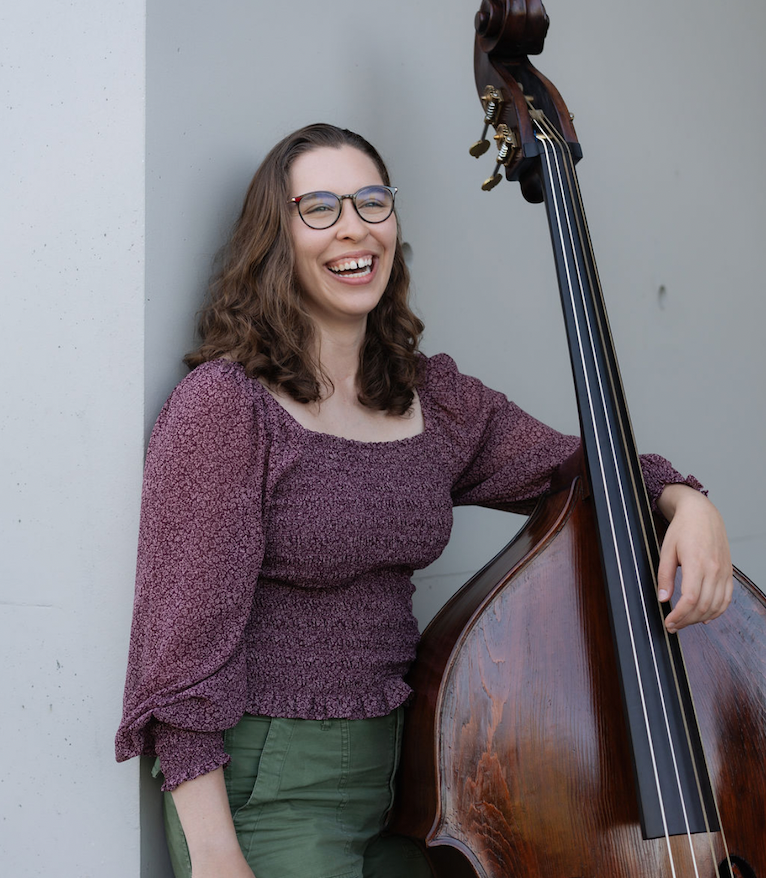
Ariel Walton
Ages 8 and up
Free intro call. Enroll when it's the right fit.
Credentials & Qualifications
What I teach
- Genres
- Classical
- Baroque
- Folk / Traditional
- Subjects
- Improvisation
- Music History
- Performance Preparation
- Sight-Reading
- Music Notation Literacy
About Me
Hello! I believe music is for everyone, and that playing the double bass is no exception. Guided by curiosity, I set attainable goals in our lessons that help build confidence as you grow as a musician. Alongside teaching, I maintain an active performing career, bringing real-world musical experience into each lesson. I specialize in early music (roughly 1600–1850), but I also draw on years of orchestral and folk music experience, with over eight years of training shaped by mentorship and collaboration at the Eastman School of Music, Juilliard, and the Koninklijk Conservatorium in The Hague.
How I Teach
I adapt my teaching style by first ensuring students feel physically comfortable on a notoriously awkward instrument, allowing the bass to work for them rather than forcing them to adjust to it. Additionally, I strive to be an excellent listener so I can understand each student’s personal goals and help guide them to their own sources of inspiration. Above all, I believe learning should feel intuitive because when curiosity is present, dedication naturally follows.
FAQ
Do students need prior experience on the bass? Not at all! I am happy to start from scratch. Is the double bass too big for my child? Just like humans, basses come in a range of different shapes and sizes so fear not! There is something comfortable for everyone to play. The sizes range from 1/4th (around 4’) to 4/4th (6’ tall). Do we need to own a bass before starting lessons? There are many rental options and some schools also offer appropriately-sized instruments What age can a child start learning double bass? They can start learning the double bass whenever they are interested! On average, bass players usually start when they’re around 9-10. It’s also common to start as a teen (14-17). Is the double bass hard to learn? The double bass is considered an initially challenging instrument. This is due to its large size, physical demands (just carrying it to the gig can be taxing), and developing separate left-hand and right-hand techniques. Do you teach both Arco (bowing) and Pizzicato? Yes! and I play both styles of bow (French and German Bow) Why is it called the double bass? In earlier music styles— think baroque period (1600-1750)— the cello (short for violoncello) played the same musical line as the bass (called a Violone), reinforcing the sound at a lower pitch. Therefore, the bass was doubling the “bass” line. How do you structure lessons? This is on a case by case basis. A good starting point is to set some longer term goals (eg. improving right hand technique, or learning the individual skills to play a challenging excerpt). During the lesson itself, we do a mix of technical and musical exploration. What kind of music will students play? An assortment of skill-level appropriate music which includes a blend of method books, pieces that students bring to the lesson, and standards of the double bass repertoire. How involved should parents be? Parental involvement is highly appreciated. Learning a new skill involves consistency and a community approach. The more involvement, the better the long term results will be. Can bass students participate in ensembles and orchestras? Absolutely! Bass players are frequently needed in ensemble playing (unlike violinists), and we actively build collaborative skills into our lessons. How much should bass students practice? This depends on the individual’s goals/attention span. My goal is to provide the tools to make practicing fun and effective. 15 minutes can be just as useful as 4 hours.
Monday
2:00 PM - 10:00 PM
Tuesday
2:00 PM - 10:00 PM
Wednesday
2:00 PM - 10:00 PM
Thursday
2:00 PM - 10:00 PM
Friday
2:00 PM - 10:00 PM
Saturday
2:00 PM - 10:00 PM
Sunday
2:00 PM - 10:00 PM
All times in
Getting started steps
Getting Started with Ariel
Meet Your Teacher
Free intro call to talk goals and see if it’s the right fit
Enroll in Class
Continue with weekly lessons when you’re ready
Schedule & Start Learning
Book lessons online, on your schedule


